Your team just invested six figures into a new intent data platform. Your dashboards are lit up. You’re drowning in “hot leads” and “surging accounts.”
There’s just one problem: your sales team hates them.
SDRs are burning out. Revenue is flat. The “high-intent” MQLs you’re passing over are met with eye-rolls and ignored. Your sales team has learned that your “actionable” data is anything but.
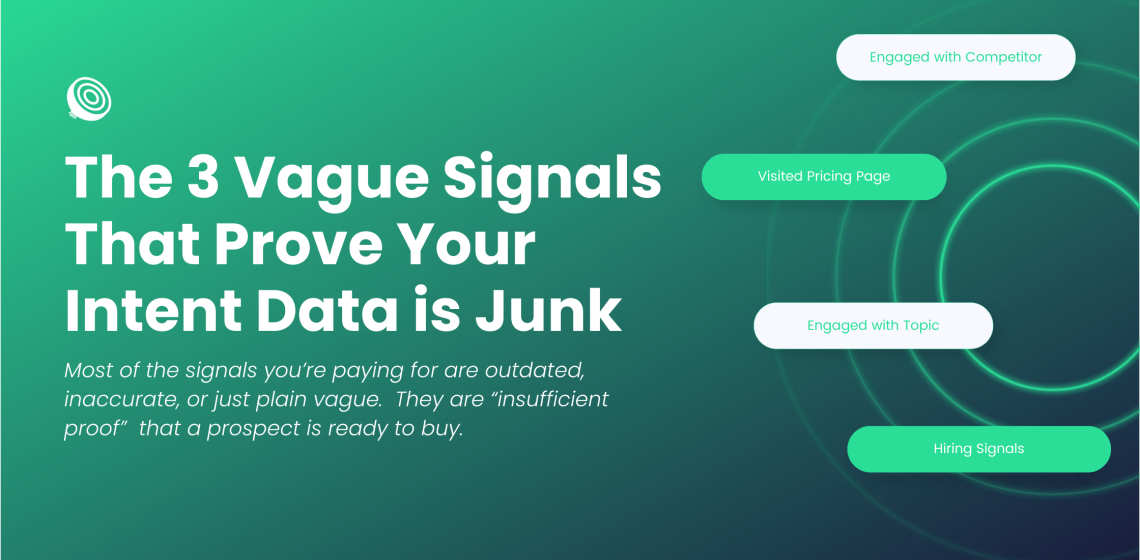
This is the dirty secret of the intent data industry. Most of the signals you’re paying for are outdated, inaccurate, or just plain vague. They are “insufficient proof” that a prospect is ready to buy.
If your sales team is ignoring your leads, it’s not a people problem; it’s a data problem. You’re not giving them intelligence; you’re giving them noise. Here are the three most common “junk” signals that are wasting your team’s time.
1. The “Vague Account Spike”
What it looks like: You get an alert: “Acme Corp is surging on ‘Cloud Solutions’!”
Why it’s junk: This is the most common and least actionable signal. It’s a “black box” alert that provides no context.
For a sales rep, this “lead” is a “profound disappointment.” They are left with a 10,000-person company and a million questions:
- WHO at Acme is researching?
- Is it the CIO with a new budget, or an intern writing a research paper?
- Is it the entire buying committee, or one engineer on a pet project?
“Accounts don’t buy… People do.” If your platform can only show you the building and not the person, your sales team has to start from scratch. They’re not getting a lead; they’re getting a homework assignment.
2. The “Anonymous Website Visit”
What it looks like: “An anonymous visitor from a target account just hit your pricing page!”
Why it’s junk (on its own): This one feels much hotter. It’s first-party data, which is great! You know an account you care about is on your digital property.
But it’s still a “what,” not a “who.”
You’re still blind. You know a company was there, but you have no idea which person at that company visited. Was it the decision-maker, or just a curious account exec from their team?
Worse, you have no idea what they did before or after visiting your site. Their visit to your pricing page is just one dot, but you’re missing the other 99% of their research journey that’s happening “off-site.” Without that context, you’re still just guessing.
3. The “Top-of-Funnel Topic”
What it looks like: “A prospect is showing intent for ‘what is ABM?'” or “researching ‘B2B marketing trends’.”
Why it’s junk (as a “hot lead”): This is perhaps the most dangerous signal. Your platform is mistaking learning intent for buying intent.
Not all research is created equal. A person searching “what is ABM?” is in “awareness mode” and needs education. A person searching “6sense alternatives” or “Lead Onion pricing” is in “decision mode.”
Your platform is lumping them all together.
This forces your sales team to commit the cardinal sin of B2B sales: pitching a demo to someone who is just trying to learn. The prospect gets annoyed, and your rep is shut down before they can even be helpful. This isn’t sales enablement; it’s sales sabotage.
Stop Buying Noise. Start Demanding Precision.
If your reps are ignoring your leads, it’s because you’re feeding them these vague, time-wasting signals. They’re forced to sift through an ocean of noise to find one drop of opportunity.
It’s time to stop paying for junk data.
A truly intelligent platform doesn’t just give you more data; it gives you precision. It’s time to demand:
- A Multi-Signal Approach: Don’t rely on one “spike.” Real intent is proven by layering 20+ sources.
- Predictive Scoring: Demand a platform that uses AI to analyze signals and tell you what stage a buyer is in – separating the “browsers” from the “buyers.”
- Person-Level Proof: Stop buying “accounts.” Demand to see the actual person – the name, title, and seniority – of the individual doing the research.
Stop wasting your team’s time. Stop paying for a black box. Demand data that’s not just “high-intent,” but actionable.
Ready to See It for Yourself?
The best way to understand how IQLs work is to try them yourself. In just a few clicks, you can start finding in-market buyers and turning intent signals into pipeline.